10 Best Stablecoins You Should Know in 2026
MAY 4, 2026 • 10 MIN READ

TL;DR: The 10 largest stablecoins by market cap as of April 2026 are USDT (~$190B), USDC (~$78B), USDS (~$11B), DAI (~$4.4B), USDe (~$3.8B), PYUSD (~$3.4B), USDG (~$2.4B), RLUSD (~$1.6B), USDD (~$1.5B), and USDY (~$1.3B). They span three categories: fiat collateralized stablecoins backed by USD reserves, crypto collateralized stablecoins managed via smart contracts, and synthetic stablecoins. Each carries a distinct risk profile, yield structure, and regulatory status. Stablewatch tracks real-time APY, TVL, and risk data across all of them.
Introduction
The stablecoin ecosystem now spans dozens of digital currencies, but a handful of popular stablecoins account for the vast majority of market demand. Their selling point is offering stability and value in a volatile crypto market across use cases from trading to reserve management.
The underlying assets held as collateral, regulatory oversight, and yield profile vary enormously. This article covers each one: what it is, who issues it, and what risk you are taking on when you hold it.
1. USDT (Tether) — Fiat Backed, Largest Market Cap
Market cap: ~$190B
Issuer: Tether Limited
Tether USDT is the largest stablecoin and the most traded asset in crypto by volume. It is the default unit of account on centralized exchanges, the preferred collateral in derivatives markets, and the dominant stablecoin on Tron and Ethereum. USDT is what traditional money looks like in digital form for most global crypto activity.
Tether Limited backs USDT with US Treasury bills and cash equivalents as reserve assets. The company publishes quarterly attestations but has never completed a full independent audit. USDT provides unmatched liquidity but has less transparent audits compared to USDC.
Use case: Trading, payments, cross-border remittances, collateral in DeFi and CeFi.
Risk note: Counterparty risk is concentrated in Tether Limited. Reserves are attested but not audited. Regulatory oversight post-GENIUS Act is the key long-term variable.
2. USDC (Circle) — Fiat Collateralized, Institutional Grade
Market cap: ~$78B
Issuer: Circle Internet Financial
USD Coin (USDC) is the regulated alternative to USDT and the preferred fiat currency-backed stablecoin for institutional investors requiring full regulatory compliance. Circle holds USD reserves in cash and short-duration US Treasuries, conducts regular audits via monthly Big Four attestations, and is dominant in Ethereum DeFi for protocols needing transparent reserve assets. USDC's high liquidity across multiple blockchains makes it the default choice for institutions entering DeFi, and the GENIUS Act framework is expected to formalize exactly the standards Circle already meets. USDC offers the highest regulatory compliance and stability among stablecoins.
Use case: Institutional DeFi, protocol treasuries, on-ramp/off-ramp for companies operating under regulatory mandates, cross-chain settlement.
Risk note: Regulatory clarity is a feature here. The primary risk is banking concentration in reserve custodians. The March 2023 SVB depeg event, where USDC briefly fell to $0.87, showed that fiat collateralized stablecoins carry banking system exposure.
3. USDS (Sky) — Crypto Collateralized, Sky Protocol's Native Stablecoin
Market cap: ~$11B
Issuer: Sky Protocol (formerly MakerDAO)
USDS is Sky Protocol's primary stablecoin, introduced with the 2024 MakerDAO rebrand. It is backed by crypto collateral and real world assets including US Treasury exposure, managed via smart contracts and onchain governance. The Sky Savings Rate (SSR) allows holders to earn yield onchain. DAI, Sky's original stablecoin, continues to circulate separately and appears elsewhere on this list. USDS provides the highest security against censorship by relying on smart contract auditability.
Use case: Decentralized finance (DeFi), yield generation via sUSDS, protocol collateral, DAO treasury management.
Risk note: Smart contract and operational risk are the primary considerations. The shift toward real world assets introduces off-chain counterparty exposure. Sky's risk framework is among the most publicly documented in the stablecoin ecosystem.
4. DAI (Sky Protocol) — The Original Decentralized Stablecoin
Market cap: ~$4.4B
Issuer: Sky Protocol (formerly MakerDAO)
DAI was the first decentralized stablecoin to achieve meaningful scale, maintaining its dollar peg through overcollateralized crypto assets managed by smart contracts. Its decentralized approach (no company holds the reserves, no custodian can freeze accounts) still holds significant value for DeFi users prioritizing censorship resistance. While Sky Protocol has introduced USDS as its primary stablecoin, DAI remains in active circulation as a core component of the DeFi ecosystem.
Use case: Decentralized finance, protocol collateral, DeFi-native dollar equivalent.
Risk note: Smart contract and governance risk via Sky token holders. DAI's backing now includes real world assets alongside crypto collateral, introducing off-chain counterparty exposure that did not exist at launch.
5. USDe (Ethena) — Synthetic, Delta-Neutral
Market cap: ~$3.8B
Issuer: Ethena Labs
USDe is the largest synthetic stablecoin in the market. Ethena maintains the dollar peg through a delta-neutral strategy: depositing crypto collateral while holding short perpetual futures positions of equivalent size. The result is a fully collateralized instrument whose funding rate income generates yield for holders of sUSDe, the staked version.
Use case: Yield generation via sUSDe, DeFi collateral, alternative to fiat backed stablecoins for sophisticated users.
Risk note: The peg depends on liquid futures markets and positive funding rates. In extreme stress, yield disappears and the peg faces pressure. Collateral is held with centralized custodians. This is a sophisticated instrument, not a passive dollar equivalent.
6. PYUSD (PayPal) — Fiat Backed, Payments-Native
Market cap: ~$3.4B
Issuer: PayPal / Paxos
PayPal USD (PYUSD) is the clearest signal that companies operating in mainstream payments are building on stablecoin rails. Issued by Paxos for PayPal, it is fully collateralized by US dollar deposits and short-term Treasuries with monthly attestations. Distribution via PayPal and Venmo gives it consumer reach no DeFi-native stablecoin can match. Among the five stablecoins on this list backed by US dollar reserves, PYUSD has the broadest retail distribution.
Use case: Consumer payments, PayPal ecosystem transfers, fintech-to-stablecoin bridge.
Risk note: Structurally sound on reserves. PayPal controls all distribution decisions, limiting organic DeFi adoption and exchange availability beyond its own platform.
7. USDG (Global Dollar) — Fiat Backed, Yield-Sharing Model
Market cap: ~$2.4B
Issuer: Global Dollar Network (Paxos infrastructure)
USDG differentiates through a yield-sharing model: reserve asset income is distributed to verified ecosystem partners rather than retained by the issuer. Built on Paxos infrastructure and fully collateralized by US dollar deposits and short-term Treasuries, it is attracting exchanges and protocols willing to integrate it in exchange for yield income.
Use case: Exchange liquidity, protocol integration, yield-sharing partnerships, global payments rails.
Risk note: Structurally sound given Paxos infrastructure and regulatory compliance. Growth is tied to partner integration decisions. Still building market demand relative to USDT and USDC.
8. RLUSD (Ripple) — Fiat Backed, Cross-Border Payments
Market cap: ~$1.6B
Issuer: Ripple
RLUSD launched in late 2024 with NYDFS approval. Backed by US dollar deposits and short-term Treasuries, it targets cross-border transactions through the XRP Ledger and Ripple's institutional payment partners.
Use case: Cross-border transactions, XRP Ledger ecosystem, Ripple's ODL network.
Risk note: Structurally clean. Trajectory is tied to Ripple's commercial reach. For users outside the XRP ecosystem, there is limited reason to choose it over USDT or USDC today.
9. USDD (TRON DAO) — Overcollateralized, Algorithmically Managed
Market cap: ~$1.5B
Issuer: TRON DAO Reserve
USDD is the TRON DAO Reserve's stablecoin and one of the few algorithmic stablecoins retaining significant market cap after the TerraUSD collapse. Unlike pure algorithmic stablecoins, USDD is overcollateralized with crypto assets including TRX, BTC, and USDT. It benefits from TRON's low transaction costs for payments and DeFi within its ecosystem.
Use case: TRON ecosystem DeFi, payments, trading pairs on TRON-native platforms.
Risk note: The overcollateralization provides a buffer, but reserve composition and governance are less transparent than fiat backed stablecoins. TRON ecosystem concentration is a key risk, and institutional investors requiring regulatory compliance should treat this asset with additional scrutiny.
10. USDY (Ondo Finance) — RWA-Backed, Yield-Bearing
Market cap: ~$1.3B
Issuer: Ondo Finance
USDY is Ondo Finance's tokenized note backed by short-term US Treasuries and bank deposits. It is one of the clearest examples of real world assets brought onchain: holders earn yield from the Treasury portfolio directly, making USDY a yield-bearing alternative to passive USD stablecoins for institutional investors and protocols seeking return without complex DeFi strategies.
Use case: Yield-bearing dollar equivalent for institutional investors, DeFi collateral, onchain Treasury exposure.
Risk note: USDY is a yield-bearing token whose price reflects accrued interest, not a fixed peg. This makes it unsuitable as a direct substitute for USDT or USDC in trading contexts. Regulatory status involves US securities considerations that limit availability in some jurisdictions.
How the Best Stablecoins Differ Beyond the Peg
All ten assets target a stable value relative to the US dollar, but the mechanisms differ enormously. The key dimensions to evaluate are:
Fiat Collateralized Stablecoins vs Crypto Collateralized Stablecoins
Dollar-pegged stablecoins (USDT, USDC, PYUSD, USDG, RLUSD) hold reserve assets off-chain with custodians — these are the fiat collateralized stablecoins. Crypto collateralized stablecoins (USDS, DAI) hold crypto assets onchain via smart contracts, with some real world assets exposure. Synthetic stablecoins (USDe) use derivatives positions to maintain the peg. USDD is overcollateralized with crypto assets but governed by the TRON DAO Reserve rather than transparent custodians. Each model carries a distinct risk profile: custodian risk for dollar-backed assets; smart contract and price fluctuations risk for crypto collateralized; funding rate risk for synthetics.
Yield Profile
Yield-bearing stablecoins are compressing the market share of passive dollar equivalents. Users holding USDT or USDC are increasingly moving to USDS, sUSDe, or USDY to earn return on idle capital. This trend accelerates as widespread adoption of yield infrastructure lowers the barrier for retail and institutional investors alike.
The yield profile is increasingly central to a stablecoin's value proposition. sUSDS earns yield via the Sky Savings Rate. USDe earns yield via funding rates when staked as sUSDe. USDY earns yield from its Treasury portfolio by design. USDG distributes reserve yield to ecosystem partners. Other assets on this list are non-yield-bearing by default.
Counterparty Concentration
This ranges from single-issuer custodial models (RLUSD, PYUSD) to diversified institutional custody (USDC) to fully onchain governance (USDS, DAI) to DAO reserve management (USDD). Understanding concentration is the starting point for any serious reserve management assessment.
What About Commodity Backed and Algorithmic Stablecoins?
Commodity backed stablecoins backed by physical assets such as precious metals and physical commodities (PAXG, XAUT) exist but remain small by market demand and by definition their value isn't stable so some venues don't even classify it as stablecoins. Pure algorithmic stablecoins are effectively absent from the top ten after the TerraUSD (UST) collapse in 2022 demonstrated structural fragility during turbulent market conditions.
Conclusion
The 10 stablecoins above represent the current state of a market still in an early structuring phase. Market capitalization rankings will shift as regulation lands and institutional investors develop stronger preferences. Some prioritize offering stability and high liquidity; others prioritize yield or a decentralized approach. The right stablecoin depends on your collateral model, risk profile, and use case — not just which one is biggest today.
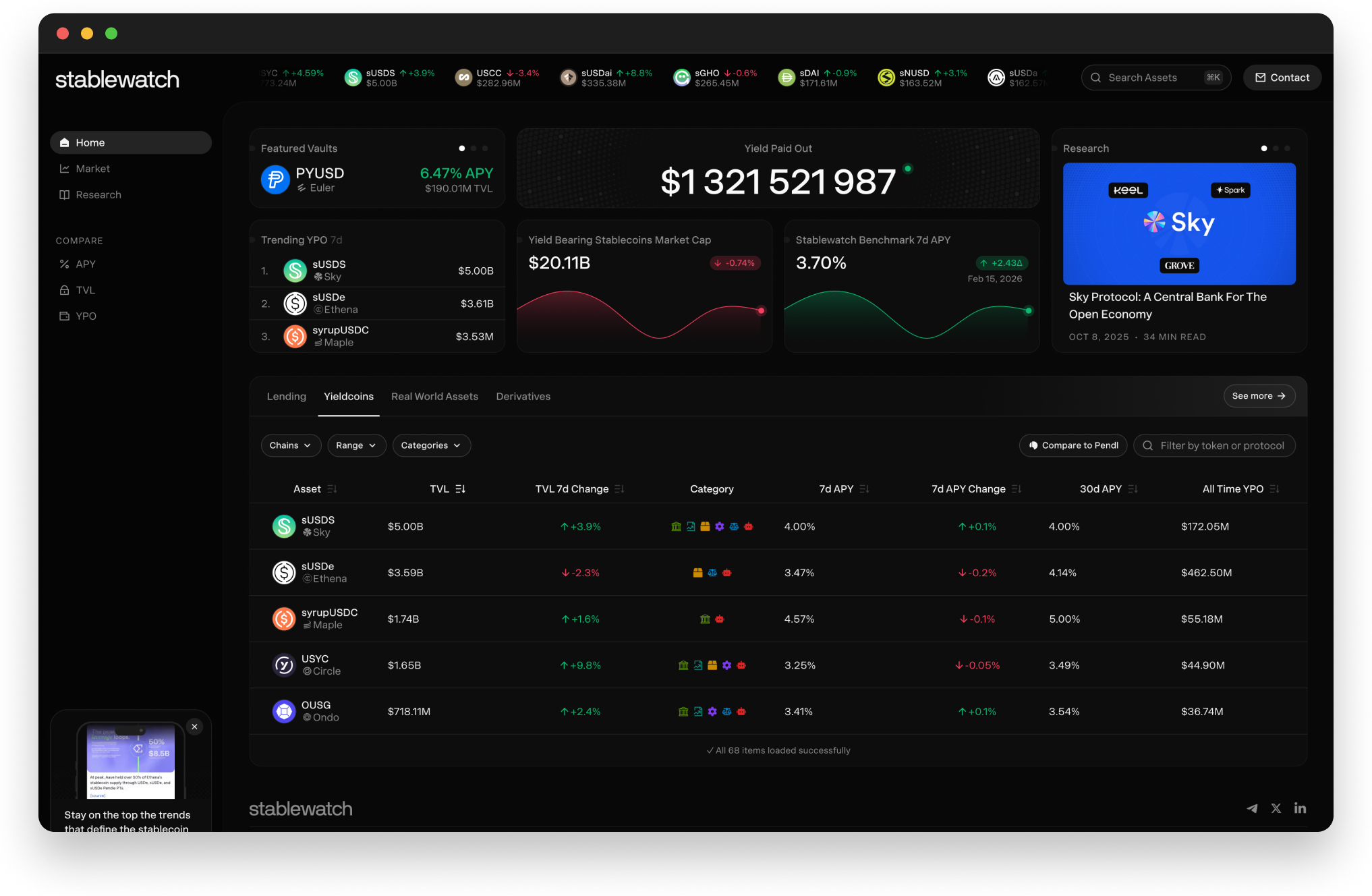
Stablewatch tracks real-time APY, TVL, and risk data across the stablecoin ecosystem.
See the [Stablewatch analytics dashboard]
FAQ
How do stablecoins enable financial inclusion and DeFi participation?
Stablecoins play a crucial role in decentralized finance by providing a stable medium of exchange that mitigates the price volatility common in other cryptocurrencies. This makes it significantly easier to enter and exit DeFi platforms without worrying about the value of your position changing between transactions. For underbanked populations who lack access to traditional banking infrastructure, this matters most: stablecoins enable fast and cheap transactions while mitigating the risk of price fluctuations, allowing users to benefit from cryptocurrency features (global transfers, lending, yield generation) without the associated volatility. The integration of stablecoins into DeFi platforms has been one of the primary drivers of greater financial inclusion globally.
Do stablecoins actually hold their peg during market stress?
Reliable stablecoins have a track record of maintaining their 1:1 value even during extreme market stress. USDT, for example, has held its peg through multiple crypto market cycles, exchange collapses, and liquidity crises since 2014. That said, historic temporary depegging events have occurred. The most notable recent example is USDC's 2023 dip during the SVB crisis, when Circle disclosed $3.3B in reserves held at Silicon Valley Bank and USDC briefly fell to $0.87 before recovering once US regulators guaranteed depositors. The lesson is not that stablecoins are unreliable, but that the specific risk depends on the reserve structure: banking system risk for fiat-backed assets, smart contract risk for crypto-collateralized ones, and funding rate risk for synthetics.
What are the main risks of holding stablecoins?
Despite their advantages, stablecoins require trust in the entity that holds the reserve assets. If that entity is not trustworthy or becomes insolvent, the stablecoin could lose its value. For fiat-collateralized stablecoins, this means custodian and banking counterparty risk. There is also the broader point that fiat-collateralized stablecoins are subject to inflation and monetary policy issues similar to their underlying fiat currencies, which can affect their long-run value stability even when the peg holds. Non-collateralized stablecoins rely on complex algorithms to maintain their value, which may not always work as expected — the TerraUSD collapse in 2022 is the defining example of algorithmic instability at scale. Beyond structural risks, stablecoins are also vulnerable to hacking: smart contract exploits, bridge attacks, and custodian breaches all pose significant risks to user funds. Mitigating these risks requires robust security measures and transparent reserve management practices to maintain user trust and stability over time.
What does reserve transparency actually mean for a stablecoin?
The gold standard for reserve transparency involves monthly third-party attestations or real-time on-chain proof-of-reserves. USDC publishes monthly attestations from a Big Four accounting firm confirming that USD reserves match the circulating supply. USDT publishes quarterly attestations but has never completed a full independent audit, which remains a point of concern for institutional users. On the crypto-collateralized side, DAI and USDS publish their entire reserve composition onchain in real time — any user can verify the backing without relying on a third party. USDY offers a different model: the underlying Treasury assets are tokenized, making the reserve directly auditable by design. When evaluating any stablecoin, reserve transparency is one of the most important risk signals available.
How is stablecoin regulation developing globally?
The regulatory landscape for stablecoins is evolving rapidly, with frameworks being developed across multiple jurisdictions. In the US, the GENIUS Act seeks to establish a federal regulatory framework for stablecoins, potentially designating the Federal Reserve as the primary overseer and setting clear reserve and audit standards. Adherence to frameworks like the GENIUS Act provides legal clarity and protection against sudden shutdowns for both issuers and users. In the European Union, MiCA regulation aims to impose strict reserve standards and oversight for stablecoin issuers, which is already influencing regulation in other regions. Comprehensive regulatory frameworks are also being developed in jurisdictions like Hong Kong and Singapore, each balancing innovation and compliance differently. The overall direction is toward greater transparency and accountability, though the pace and specifics vary by jurisdiction. This evolution will likely benefit well-capitalized, compliant issuers like Circle and Paxos while creating headwinds for less transparent operations.
Author
Maja
Maja