Research
Stay ahead of the evolving stablecoin landscape with our curated insights and reports.


Robinhood Vault: Retail Lenders, Institutional Borrowers
Borrowing-Side Analysis of the Steakhouse USDG Vault on Morpho Abstract. Robinhood Chain, and particularly the Steakhouse-curated Robinhood Morpho vault, has emerged as one of this year’s most notable DeFi launches. Within just one month, the vault reached $600M in TVL and originated $287M in loans, growing faster than comparable DeFi lending pools. The lender side is well understood: Robinhood’s 27 million users can deposit USDG through the app and earn a 7% APY. Until now, however, little ha
AUGUST 11, 2026 • 13 MIN READ

The Missing Backstop: Protection for the Onchain Yields
Robinhood Earn represents the flagship example of offering the off-bank yield to mainstream retail. The platform promises a self-custodied 7% yield on Paxos-issued USDG directly within its app interface, and an insurance wrapper anchors the consumer proposition. Read the underwriting disclosures, however, and there is a bit of a surprise. Underwritten by Lloyd's and Relm, the policy covers cyber incidents and smart contract exploits, but explicitly states it "covers Robinhood; it is not a person
AUGUST 5, 2026 • 24 MIN READ

The Asymmetric Cost of Money: Why the Consumer Yield Rail is Migrating Off-bank
A record $875 billion in US Commercial Real Estate (CRE) debt is scheduled to mature in 2026, and banks hold the largest share: $396 billion, concentrated in the regional and community banks that are least able to absorb it. Mortgage Bankers Association (MBA) data confirms that this maturity wave forces local institutions to protect their own capital instead of paying competitive rates to depositors. Refinancing the maturing debt ties up the cash that could otherwise fund higher deposit yields.
JUNE 4, 2026 • 17 MIN READ

What Is YPO? Yield Paid Out, Explained
TL;DR: Yield Paid Out (YPO) measures the actual yield distributed to token holders over a given period. Unlike APY, which is a forward-looking rate, YPO is a realized figure. It counts only yield delivered in stablecoins or in-kind, excluding points, governance tokens, and manually claimable rewards. APY tells you the rate, TVL tells you the size but neither tells you what holders actually received. The Problem With APY Alone APY tells you what a protocol is offering. It does not tell you wha
MAY 29, 2026 • 3 MIN READ
Stablewatch Incubates Osero with a $13.5M raise
A year ago, a question kept coming up in our work as a yield intelligence platform: stablecoin yield exists and works, so why are intuitive savings account options so limited within existing stablecoin platforms? Something so obvious in traditional banking, yet so rare onchain. Neobanks started to pop up to address the gap between fintech experience and the crypto audience. Yet still, the majority of them lack access to the premier onchain risk-adjusted yield. The data is clear. There are $300B
MAY 12, 2026 • 3 MIN READ

10 Stablecoins You Should Know in 2026
TL;DR: The 10 largest stablecoins by market cap as of April 2026 are USDT (~$190B), USDC (~$78B), USDS (~$11B), DAI (~$4.4B), USDe (~$3.8B), PYUSD (~$3.4B), USDG (~$2.4B), RLUSD (~$1.6B), USDD (~$1.5B), and USDY (~$1.3B). They span three categories: fiat collateralized stablecoins backed by USD reserves, crypto collateralized stablecoins managed via smart contracts, and synthetic stablecoins. Each carries a distinct risk profile, yield structure, and regulatory status. Stablewatch tracks real-ti
MAY 4, 2026 • 10 MIN READ

What Are Stablecoins? The Complete Guide to How They Work, Their Types, and What Risks Actually Matter
TL;DR: A stablecoin is a crypto asset designed to hold a fixed value, typically pegged to $1. They come in four main types: fiat-backed, crypto-collateralized, algorithmic, and RWA-backed. Yield-bearing stablecoins earn a return on top of that peg. Understanding which mechanism backs a stablecoin, and how resilient that mechanism is under stress, is the only framework that matters when evaluating one. This guide covers all of it: how stablecoins work, how they are used for payments, how they are
APRIL 30, 2026 • 18 MIN READ

Transparent Liquidity: Private Credit Contagion and the Rise of Institutional DeFi
Stablewatch Memo #2: Recent weeks provided a clear demonstration of how modern financial systems handle stress. When redemption requests hit 9.3% of outstanding shares, BlackRock gated its $26 billion HLEND fund, trapping investor capital behind a 5% quarterly cap. Meanwhile, onchain lending protocols processed over $51.7 billion in stablecoin volume that same month without interruption, serving tens of thousands of active borrowers at rates competitive with the very market now seizing up. The
MARCH 25, 2026 • 15 MIN READ

Stablewatch Joins Sky Ecosystem as Core Contributor
Delivering Institutional-Grade Risk and Data Infrastructure to DeFi's Largest Balance Sheet Onchain yield markets have crossed $20 billion. The infrastructure to assess risk, compare opportunities, and satisfy due diligence has not kept up. Stablewatch is here to fix that. As a new core contributor to the Sky Ecosystem, Stablewatch is collaborating on Sky’s Laniakea Project: the data, compliance, and risk layer for the protocol behind USDS, the world's largest decentralised yield-generating st
MARCH 19, 2026 • 3 MIN READ

The Infrastructure Gap: Financing the AI Frontier
AI infrastructure spending is reshaping credit markets. How collateralized lending, DeFi rails, and asset-based finance are closing a multi-trillion-dollar funding gap.
FEBRUARY 16, 2026 • 11 MIN READ

The Stablecoin Economy’s Identity Crisis: idOS Explained
This article was made possible with the support of @idOS_network Executive Summary The stablecoin economy has transitioned from a crypto niche into a $290 billion financial powerhouse, and is currently experiencing an explosive growth, characterized by an 89.4% YoY surge in volume. This rapid expansion, underpinned by formalizing legislation such as GENIUS and MiCA, has established digital assets as bank-grade financial tools. However, the industry is being slowed down by a last-mile problem:
JANUARY 29, 2026 • 19 MIN READ

Aave V4: The End of Fragmented Liquidity
Aave V4 Since its inception in 2017 as ETHLend, Aave has been a pioneering force in DeFi, emerging as one of the first protocols to enable peer-to-peer lending on Ethereum. Over the years, it evolved into a dominant player in the DeFi lending landscape, boasting billions in total value locked (TVL) and setting standards for non-custodial borrowing and lending. Through iterations like V2 and V3, Aave introduced innovations such as flash loans, E-Mode, isolation mode, collateral swaps, and effici
DECEMBER 12, 2025 • 8 MIN READ

Yield-Bearing Stablecoin Landscape 2026: Market Data and Protocol Analysis
This article is part of the Redstone “Yield Bearing Assets & Stablecoins Report 2025”, where Stablewatch is a co-author. The architecture of the digital asset economy is on the cusp of a fundamental transformation, catalyzed by the Guiding and Establishing National Innovation for U.S. Stablecoins (GENIUS) Act. A landmark piece of legislation, the Act creates a deliberate divide of the stablecoin market into two distinct classes: federally regulated, non-yielding “Payment Stablecoins” for pure
NOVEMBER 12, 2025 • 17 MIN READ

x402 and the Architecture of an Autonomous Economy
AI's Value Bypass The proliferation of generative AI has introduced a systemic inefficiency into the digital economy. It arises not from a flaw, but from a fundamental architectural incompatibility between how autonomous agents consume information and how the web has historically monetized its creation. The result is the "value bypass" problem. The internet's entire economic model, predicated on capturing human attention (ads) or loyalty (subscriptions), is being systematically bypassed by non
OCTOBER 31, 2025 • 10 MIN READ

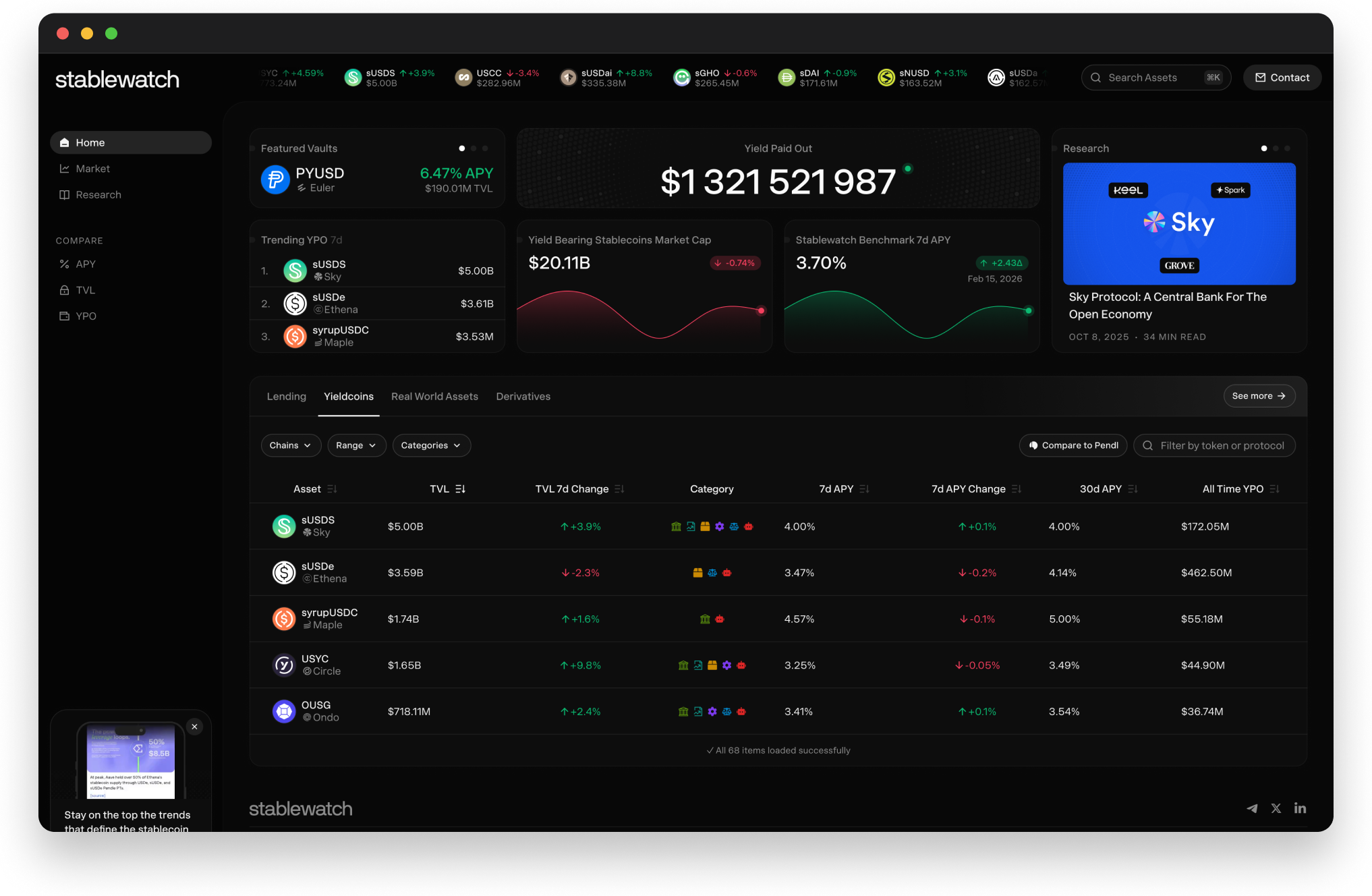
Stablewatch V2: The next Generation Stablecoin Analytics
The Yield-Bearing Stablecoin (YBS) market has fundamentally evolved into a complex, multi-billion dollar ecosystem. Navigating this landscape today demands more than simple APY trackers; it requires a sophisticated, data-driven framework. To accommodate for the growing complexity of this market, we are launching a major evolution of the stablewatch.io analytics platform. Our new dashboard builds upon the robust analytical foundation, redesigned as a comprehensive command center engineered to he
OCTOBER 30, 2025 • 4 MIN READ