What Is YPO? Yield Paid Out, Explained
MAY 29, 2026 • 3 MIN READ

TL;DR: Yield Paid Out (YPO) measures the actual yield distributed to token holders over a given period. Unlike APY, which is a forward-looking rate, YPO is a realized figure. It counts only yield delivered in stablecoins or in-kind, excluding points, governance tokens, and manually claimable rewards. APY tells you the rate, TVL tells you the size but neither tells you what holders actually received.
The Problem With APY Alone
APY tells you what a protocol is offering. It does not tell you what holders actually received.
A protocol can advertise 15% APY. But the number is often built on shaky ground. The most common scheme: yield denominated in a governance token that does not yet exist, has no defined TGE date or process, and is valued at a number the team invented. The token may never launch. If it does, the market valuation will bear no resemblance to the figure used to calculate the rate.
The second variant is subtler: yield paid in a real governance token that has already lost 80% of its value, or structured as manual claims that most holders never take action on. In both cases, the realized return for the average participant is a fraction of the headline number.
What YPO Measures
Yield Paid Out is the cumulative yield distributed to token holders over a defined time window. Stablewatch calculates it by summing all yield payments made during that period.
A yield payment qualifies as YPO if it falls into one of three categories:
- A reward payment distributed directly to token holders
- A claim of a reward made by a token holder
- A change in the redemption price of the yield-bearing asset (the standard mechanism for rebasing or accumulating tokens like sUSDS or sUSDe)
YPO excludes points programs, governance token rewards, and incentives that are not paid in-kind or in stablecoins. Points are speculative by nature, and governance tokens introduce price exposure that is not related to the underlying asset. Including them would inflate the number without reflecting what holders actually earned in stable terms.
How YPO Is Calculated
YPO is a function of two variables: TVL and APY over time.
At its simplest: if a protocol holds $500 million in deposits and distributes a 10% annualized yield, it pays out $50 million per year to holders. That $50 million is the YPO.
In practice, both TVL and APY fluctuate. Stablewatch tracks these movements continuously and aggregates the resulting yield payments to produce accurate YPO figures across daily, weekly, monthly, and cumulative timeframes.
Why YPO Matters
YPO is a protocol health signal that APY and TVL cannot provide individually.
It reflects capacity to sustain yield. A protocol with $1 billion TVL and a 5% APY generates more YPO than a protocol with $10 million TVL and a 50% APY. High-rate, low-TVL protocols often cannot maintain their rates as deposits grow. Protocols with high YPO have demonstrated the ability to sustain meaningful yields even with significant capital deployed.
It filters out noise. Protocols with artificially inflated APYs supported by governance emissions or unsustainable incentive structures will show low or declining YPO over time.
It makes protocols more comparable. APY and TVL alone are not sufficient to evaluate a protocol. APY tells you the offered rate, not what was delivered. TVL tells you how much is deposited, not whether the yield source behind it is durable. Two protocols with identical APY and TVL can carry completely different risk profiles depending on whether the yield comes from T-bill income, lending spreads, or leveraged funding rates. YPO adds the realized dimension that the other two metrics cannot.
What High YPO Signals
Consistently high YPO, relative to protocol size, indicates three things:
First, that the underlying yield source is real and is being generated at scale. Protocols dependent on unsustainable emissions will see YPO decline as incentives dry up. Protocols with durable yield sources, such as lending spreads or RWA income, maintain YPO over time.
Second, that the protocol is attracting and retaining capital. YPO grows when TVL grows. Sustained YPO growth means depositors are not only entering but staying, which is the hardest form of product-market fit to fake.
Third, that the distribution mechanism is functioning. A protocol can generate yield on paper but fail to distribute it correctly. YPO confirms that the yield has moved from the protocol to the holders.
YPO on Stablewatch
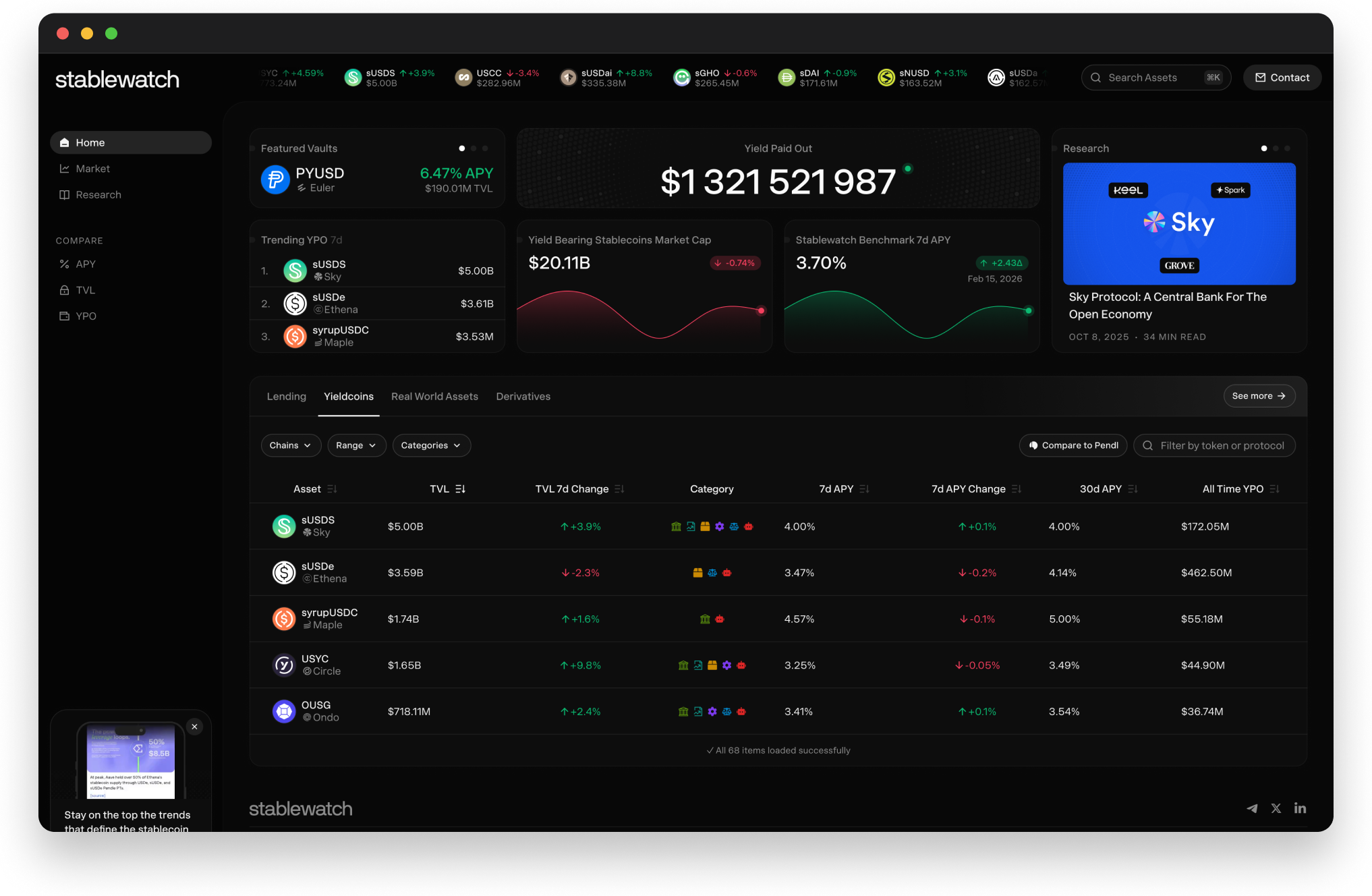
Stablewatch tracks YPO across the yield-bearing stablecoin market. You can view YPO figures for individual assets on their analytics pages alongside APY, TVL, and risk data. The combination of these four metrics gives a more complete picture of an asset's performance than any single number can provide.
Stablewatch tracks YPO, APY, TVL, and risk data across 60+ yield-bearing assets. All figures are updated real time here.
Author


Enjoyed this read? There's more.
Get Stables Weekly, our free newsletter covering the latest stablecoin market trends and insights. Delivered to your inbox every Friday.